Difficult dining in Merton

IMG_0666

For Sunday lunch The William Morris Riverside’s location passes with flying colours but food and service fails miserably.


Like most visitors, coming via the hectic A24 and A36 junction, our hopes weren’t high. On arrival however, William Morris’ Riverside Merton’s an hidden oasis. Tucked-away from traffic mere minutes away, it’s walled-in by Wandle River’s willows.

Abbey Mills’ craft stalls, eateries and open-air entertainment complete the illusion, providing a pleasant day out, even on a chilly early-spring Sunday. Unfortunately too cold to enjoy their perfectly placed river-terrace balcony, we opted to eat indoors. My English companion anticipated the enticing Traditional Sunday Roast scribbled on the sandwich board outside.

Entering, despite the delightful decor, exposed brickwork and an abundance of dark-wood, the missing manager to meet us reduced our expectations. Appearances really are deceiving. There were blackboards – each listing what we assumed were different specials. Maybe they were going for an academic theme and we were meant to memorise these? Ahead lay the bar, which wasn’t too busy. From his manner the barman seemed to be in charge. After my friend politely explained we wanted to eat in the restaurant any friendly pub illusion vanished entirely.

“Just a minute,” he snapped, simultaneously pulling pints for nearby guests. Another waiter/barman, we couldn’t tell, scurried around busily behind him. Through the bar we could clearly see the crowded conservatory-style restaurant and the Wandle winding past.

Maybe I’d misread the blackboard boast, but I’m sure the “Vision”, said: “…most welcoming pub”; “…friendliest staff”. I’ve checked the website and wasn’t wrong. “MOST” is capitalised.

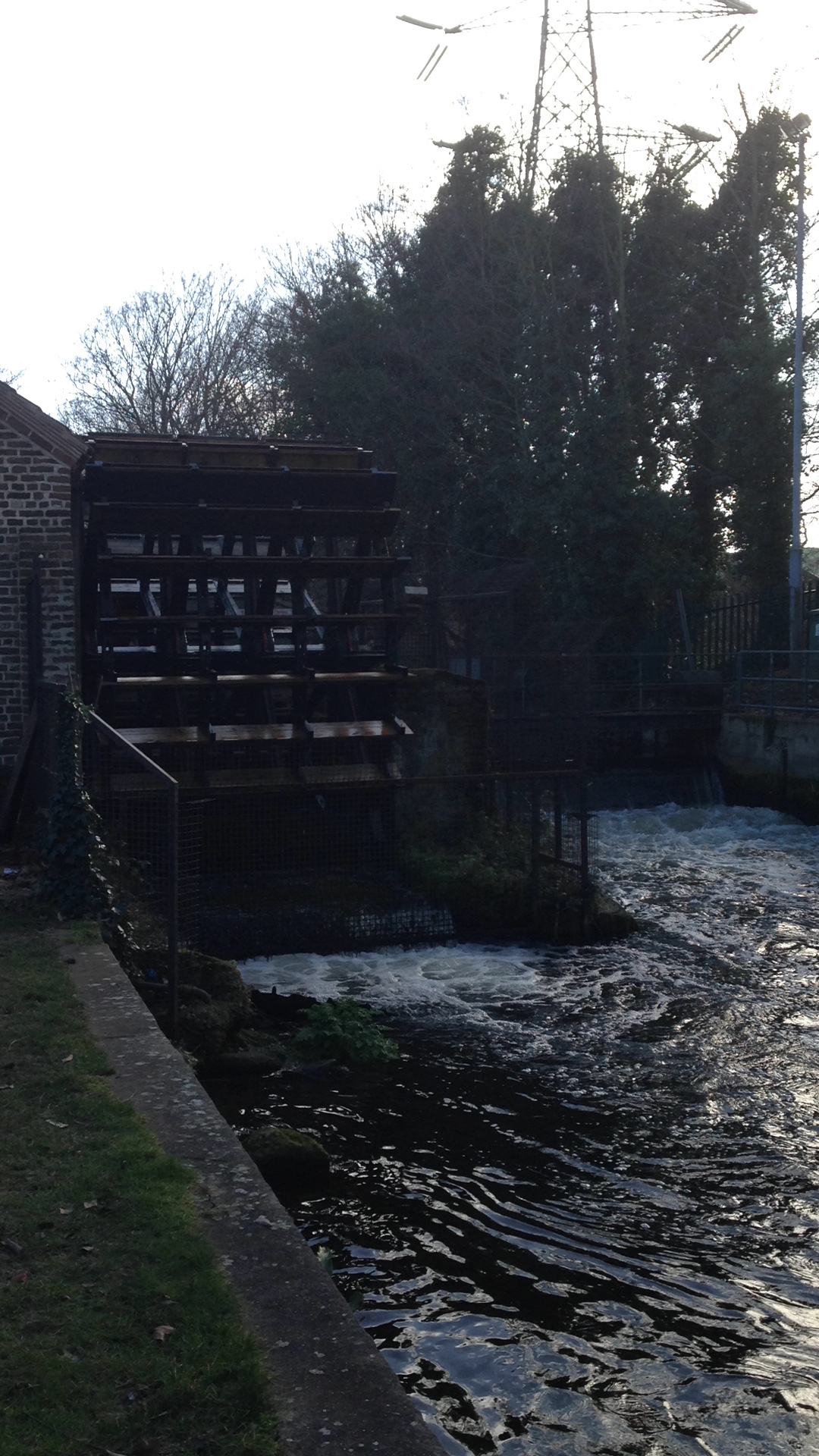
We decided to seated ourselves. The corner table near a door to the river looked empty and once seated, after pinching a chair from another table, I could see Abbey Mills eponymous waterwheel. At least the view looked lovely.

Sadly, last year’s Christmas lights still stayed strung round the room by masking tape. Available for functions, perhaps they were last night’s? It was still a pity, more because they highlighted the place’s poor paintwork. Must try harder, I thought. The worried waiter was certainly trying, hurrying by several times in five minutes.

Having done my homework, I thought I’d try the lamb shanks with mustard mash on one of the many blackboards after I checked what else was available on our missing menus when they arrived.

Eventually my eagle-eyed companion spotted a pile on the bar, hidden amongst glasses and preserve jars – possibly for last night’s candles? I have no answer for the ever-increasing pile of glasses. There were no restaurant blackboards for specials, they were by the door but I guess if you’d studied hard you wouldn’t need them. No cheating now.

Retrieving two, our original barman/waiter spotted him and yelled he’d be over soon but as his tone was the only snappy thing he possessed we waited  a lot longer. The worried waiter, almost as distressed as his black jeans, tried to tackle ten tables, plus help his boss/co-worker and the kitchen.

Another waitress/barmaid appeared at the restaurant’s far end but we never saw her again. Was she looking after the Family Area? We knew one existed having heard children and noting when entering, yet another blackboard above an empty door frame helpfully marking it. No clues to the door’s location, or why several still reasonably behaved children sat in the main restaurant.

Needing a nibble, we studied our menus seeing the selection of roasts at the top, just as the stressed server brought two sizable servings of roast chicken to the wrong table. He placed both on the bar and disappeared, while I reconsidered my choice.

As it approached 2pm, the promising Riverside Sunday Roast Menu confused us. Maybe we got extra marks working this out? Following Roasts, Start with… featured: soup of the day; bread; olives; and dips. Beneath, Bar bites… with: chips; onion rings; a strange gap; chips with truffle oil; then nachos. A long list of Mains… drifted into the next column.

Deciding to try chips with truffle oil, sea salt and Parmesan with our drinks, the brusque barman eventually arrived so we also ordered our meal, as we didn’t know when he’d return. We’d confused him and he grew increasingly impatient.

“No, chips and truffle oil to start, not as a side, with our drinks,” I explained slowly teaching him his menu.

“They’re not a side are they?” my friend asked.

As they never arrived, we never found out. Brusque barman, he never introduced himself, disappeared. The glasses grew higher. We weren’t alone in our irritation as other guests began to lose patience.

After over 15 minutes our drinks arrived. I had apple juice and my friend a cider. Just as well we didn’t want wine – we never saw a wine list. It’s a good thing we weren’t overly thirsty either, that was the only drink we were offered all afternoon.

I’ve looked online. The wine list is short but soundly stocked with reasonable prices. Again unnecessarily complicated, especially for staff, there are three glass sizes instead of just two. Were staff being tested too? From their faces it certainly seemed so.

Employing three clearly untrained waiters to cover over ten tables, another dining room and double as barmen is unrealistic. This is management’s responsibility and it’s greed not economy. Even without a more expensive restaurant manager, a relatively inexpensive weekend barman would solve most of this place’s problems promptly.

Over 30 minutes after sitting, starters appeared. We were famished. Rolls and butter would help a busy kitchen during what must be one of the Riverside’s busiest days.

I’d ordered soup of the day – meant to be mushroom it wasn’t. Containing a considerable quantity of mushrooms, the thick brown liquid surrounding them looked and tasted suspiciously of onion gravy. My friend, tasting it, agreed. I left over half.

His hummus, taramasalata and grilled bread was passable but hummus looked though it was left out uncovered overnight. It was merely mashed chickpeas: there wasn’t enough olive oil and no garlic kick. Taramasalata was tasty but too watery. When, eventually, our starters were cleared, no one asked how they were or why we’d left most of them.

20 minutes later the meaty mains arrived doing a detour to two vegetarians at an adjacent table, one of who wasn’t eating.

Plentiful portions seemed more because the chef tossed everything on the plates quickly. Yes it was pub fare but a little food presentation doesn’t hurt. Salt and pepper would have helped.

My “tender” lamb shank” was not. I cook these often, one reason I’d ordered it. Lamb should fall off the bone. This was overcooked and my suspicions about the onion gravy earlier were confirmed when I tasted what covered it. The mustard mash was lumpy and dry, with far too much mustard. The red cabbage OK, but I don’t really like red cabbage and it wasn’t mentioned.

My friend’s roast beef passed. Thankfully he likes his well done as he wasn’t asked how he liked it cooked. The roast potatoes were good but carrots overcooked too and despite the proclamation: “all roasts come with traditional trimmings”, there was no Yorkshire pudding. He ate his meat and potatoes leaving most of the rest eating some of my red cabbage, which he enjoys.

Not wanting dessert, at nearly 3.30pm we requested the bill, watching children now as restless as their poor parents starting to run around the restaurant. What’s the point of a Family Dining Area we wondered? An outside play area is difficult by a river but, if it features good fencing and used only with accompanying adults, it’s not impossible.

The vegetarian and her companion explained to the waiter/barman in jeans they needed to go soon. Apologising for the delay, he offered them a complimentary drink. Why weren’t we offered anything we wondered? In the bar area the TV came on for the football. I don’t mind football in pubs but if the restaurant plays music couldn’t the volume be off?

The bill, when it arrived, was reasonable. £42.05 after we’d deducted £3.50 for the missing chips with truffle oil. There was no service in every sense. By now we were keen to leave but our waiter, the snappy barman, asked if everything was OK.

“Not really,” I answered honestly but politely.

“Why?” he snapped back as if I’d insulted him personally.

Listing our grievances, my friend suggested they needed more staff.

“Ha!” he laughed, “Try telling my manager that!”

Our lesson was complete.

The William Morris Riverside

20 Watermill Way

London SW19 2RD

Ph: 020 8540 0216

Food served Monday to Saturday 12pm – 9pm Sunday

Lunch for two, without wine or desserts £42 without service

Rating: 2 out of 5

Rick Stein’s Down Under discoveries are deliciously different.

rick_stein01

Photo: Creative Commons

Rick Stein (Photo: Thomas Ridley Foodservice via Creative Commons)

BBC2’s A Cook Abroad: Rick Stein’s Australia featured culinary curiosities surprising even this gourmet Aussie expat…

Visiting my Australian home for the first time in five years last Christmas, last night I returned, watching celebrity chef Rick Stein’s episode of BBC2’s: A Cook Abroad: Rick Stein’s Australia.

Viewers were taken on a tasty tour through Aussie cuisine’s past and future, usefully utilising Stein’s 30-year association with the country. Visiting the Sydney digs where his cooking aspirations began, he showed how a nation formerly famous for burnt “snags on the barbie”, now served sophisticated mouth-watering meals, rivalling restaurants worldwide.

Even meat pies, my own school canteen childhood favourite, had grown up. Once soggy pastry cases holding little but gravy, these were now filled with exotic meats like kangaroo.

Considerable time was spent showcasing the country’s fish and seafood but considering this is Stein’s forté and Australia, the world’s largest island, this was understandable.

What lifted the programme, making it so fascinating, was contrast – the continent’s evolution from culinary backwater to producing foods for the future. Interesting ingredients from exotic meats to native herbs, fruit and vegetables, that Aboriginals cooked with for millennia and local chefs proudly proclaimed were the next big foodie fad.

Tasmania, formerly Australia’s Isle of Man, was the new gourmet-go-to. Although its cool climate has produced world-class wine for some time it was, until recently, seen as little more than a hippie-hideaway by mainlanders. On my last visit I’d heard surprising rumours through friends and family of the Island State’s new restaurant reputation.

Jumping from “Tassy” to nearby Bruny Island, Stein met a pig farmer turned wallaby hunter. This metre high mammal resembling a small kangaroo is now in high demand for its tasty flesh. Shy, nowhere near as common, the kangaroo’s cute compact cousin is protected on mainland Oz.

On Bruny Island, off Tasmania’s coast, an estimated 10 million wallabies thrive, decimating crops. Stein accompanied him on a night-hunt to shoot a fresh victim, then watched him prepare fresh “free-range native bush meat” and one killed earlier, left to hang. Due to its high muscle content wallaby meat is tough. It looked delicious and Stein stuffed it down. This was not a show to watch while hungry.

The foods’ diversity plus Stein’s hosting, although his cheeky-chappy routine can often grate, were excellent. Pigs wandered around the hunter’s farm, hinting at the past but this show focused firmly on Australia’s food future. Avoiding the clichés often seen on many Australian-themed programmes, even the music was understated – not a didgeridoo was heard. Featuring fascinating facts, it was tasty television in every sense.

Returning to mainland Tasmania, next stop was a distillery due to its superb single malt: the world’s best. Scottish viewers probably switched off at this point but, Tasmania’s Scottish cool climate, lakes and mountains, helpfully highlighted, it rang true. A single malt, lover myself I hungered to go but 70 per cent proof and, astonishingly, £20 thousand a bottle, this was sadly outside my budget.

Inland fish farms further highlighted Australian food’s ethical environmental emphasis. Who knew Japanese sushi chefs prized Tasmanian salmon more highly than any other?

Stein almost went too far during a corny dash delivering fresh salmon to the renowned Japanese sushi chef resident in a sleepy Tasmanian backwater. But the mouth-watering morsels the sushi chef prepared and his sublime knife wielding skill made up for it, demonstrating why people travel from everywhere to eat there. As Stein said: “Tasmania’s hidden secrets need advertising.”

Watching this I wanted to go and suspect I wasn’t alone.

25 per cent of global abalone, one shellfish I’ve never tasted, is Tasmanian, 75 per cent sent to China. Renowned in Melbourne and Sydney, it’s not familiar across most of the mainland. A slow-growing mushroom-like mollusc, if cooked incorrectly this delicacy tastes like “boot leather.”

A fisherman cooked his in ghee aboard his boat, serving it with one of Tasmania’s famous Chardonnays. Stein devoured it, dubbing it: “The best seafood Australia isn’t eating.”

Delicious TV – this was the BBC at its best. Stirring renewed patriotism within me, I loved the environmental emphasis, especially considering Australia’s current Government, refuses to acknowledge climate change. Timely, tasty, it captured Australian character, and potential, perfectly.

Bull: Young Vic Theatre

Featured image

©iStock.com/AdrianHillman

The empty boxing ring of Soutra Gilmour’s stark stage cleverly evokes conflict even before Mike Bartlett’s Bull begins. With the front few rows removed from The Young Vic’s in the round production, many audience members stand, some hanging off the metal barrier surrounding the arena-like stage.

With Peter Mumford’s harsh overly bright stadium style lighting and thumping motivation music used before the play starts, audience anticipation is heightened for a fight. Only a water cooler in one corner and familiar generic carpet seem oddly out of place, hinting at the play’s office setting.

The tension between Thomas (Sam Troughton) and Isobel (Eleanor Matsuura) is evident the moment both enter the “ring”. The verbal sparring is mutual but it’s quickly clear Thomas is on the ropes. Superior in every way, Isobel toys with Thomas the way a bored cat plays with an injured bird. Thomas valiantly tries to keep up but, rapidly realising his inadequacy, every insult seems to visibly crumple him.

The entrance of Adam James’ swaggeringly sadistic Tony could not come at a worse point for Thomas. Tony immediately joins Isobel in her sadistic game, a game in which one player doesn’t understand the rules and struggles to keep up.

Like nasty schoolchildren tormenting a weaker classmate, the childish cruelty becomes increasingly vindictive and difficult to watch. Audience laughter at occasionally amusing insults hesitates, gets more infrequent. At first almost silly, put downs become increasingly personal. Alliterative sentences are thrown like darts designed to hurt and they do – you feel for Thomas’ struggling, vainly, to survive.

The entire cast is pitch perfect. Matsuura’s Isobel resembles a beautiful deadly animal – you want to look away but remain fascinated by her viciousness unable to avert your gaze.

Troughton’s performance as the tragic Thomas is almost too painful to watch. He plays straight into his colleagues’ hands, becoming increasingly hysterical and paranoid after their boss, Neil Stuke’s cool, collected and equally cruel Carter enters. As it quickly becomes clear Carter is playing too for Thomas, the game is lost. Facing all three in a wall of hostility and complete indifference, his career disintegrates.

Clare Lizzimore’s taut direction is superb. Using the minimal space to devastating effect, the action is relentless and the production’s every phrase painful. Even worse than the verbal venom in Bartlett’s savage play are his Pinter-like pauses. Almost eternal they swallow poor Thomas, further wearing him down.

Despite Thomas’ career crucifixion, this humiliation still isn’t enough for his antagonists. Their poorly pretended pity is even crueller, the final scene delivering a hammer blow.

Although brief, nearly an hour of non-stop spite makes Bartlett’s Bull an emotionally exhausting albeit, timely, comment on today’s target driven, professionally preoccupied world.

The ugly face of British nationalism

EDL Rally (Photo: Rob Whitson)

EDL Rally (Photo: Rob Whitson)

In Whitehall on lawns opposite Downing Street, something other than the cool change made me shiver Saturday.

Exiting Charing Cross station numerous St George’s flags are visible, flying at the top of Whitehall near Trafalgar Square. My first thought is Unionists are celebrating their referendum victory. Getting closer, the flags’ and separate banners’ slogans: “No Surrender”; “No More Mosques”; “No Sharia Law”; “Supporting Our Troops” reveal a more sinister, dangerous nationalism though.

Asking one of many police nearby, I’m told the English Defence League (EDL), the South East Alliance and other far-right groups are uniting in protest against the “Islamic threat” to Britain. Previously dismissing them as mere lunatic fringe groups, I’ve always walked past. This time I follow to see what exactly they hope to gain.

There’s a raucous march down Whitehall, EDL supporters yelling and chanting. They try to get as close as possible opposite Downing Street when they’re confronted by a small but highly vocal anti-fascist rally organised in opposition. The police keep both groups apart. Once the EDL are set up on the MoD lawn more police line up to separate them from the traffic and tourists walking past to Westminster and Number 10. It strikes me just how many police there are and what else they could be doing.

Standing on the small island surrounding the Women of World War Two monument in the middle of the road, I watch and listen.

One of the most noticeable things is how clearly inarticulate and badly educated most of the crowd, consisting of men, women and children of all ages are, including nearly all the speakers.

An elderly English couple visiting London are standing nearby taking photos. We begin talking, their contempt for the group opposite quickly becoming apparent. I point out just how young some of the children are – mostly “mini-mes” of the men with matching football shirts and shaved heads.

“Look – they don’t stand a chance. They’re indoctrinated with this idiocy. Give me the child and I’ll show you the man,” says the gentleman.

I point out how few people are actually there in opposition to the rally and the numbers of people who walk by, seemingly oblivious.

“They don’t call them ‘the silent majority’ for nothing do they? What worries me is it’s the squeaky wheel that’s getting the oil now. Look at the rubbish the politicians are coming up with to counter Salmond and UKIP,” the woman says.

Their main speaker, sacked UKIP parliamentary candidate Paul Weston is now head of the far-right Liberty GB. Weston rants about Rotherham child abuse and ISIL, reading what he claims are Sharia Law edicts condoning rape and murder. Whipping the 200 or so strong crowd into a frenzy, he claims Islam is a “cult not a religion”.

Frighteningly familiar complaints begin about British jobs for British citizens, foreigners on benefits and the blood of brave British troops being spilled to battle Islam’s evil influence.

Nearby stands Viscount Alanbrooke’s statue, one of Britain’s great Second World War heroes. One of the soldiers they believe they fight for he looks away, seemingly embarrassed.

Stressing today’s event is going well and how pleased police are with today, Weston emphasises its peaceful nature. The speech stops to rapturous applause as the EDL anthem is played via speaker: “We’re coming! We’re coming! We’re coming down the road! We’re volunteers of the EDL, we’re coming down the road!”

Everyone’s chanting the words when, with no warning, protestors, police and paparazzi run back towards Trafalgar Square. Keeping up, a freelance photographer explains to me despite common beliefs rival groups usually fight among themselves over who’s more far-right. When we arrive at a pub on the northern end of Whitehall the brawlers have fled into the West End.

I stand by Northumberland Avenue taking notes watching as a large group of 20-somethings make monkey noises in earshot of a lone black police officer. He smiles politely. His white colleagues nearby however fail to intervene despite police easily outnumbering protestors by about three to one.

Asking the officer how he feels about all of this he just shrugs.

Seeing me taking notes one of his colleagues asks if I’m a journalist. I explain I’m just starting, my first time covering anything like this and my surprise at the number of police. Explaining this, he goes on to confirm something else I’d noticed:

“It’s the first time we’ve had such a poor show from the anti-fascists.

“The EDL are usually the better behaved out of all of them. The problem is they cause such an adverse negative ripple around them.”

Asking why he did nothing to stop the monkey chants he says he didn’t hear them: “You get used to that in the police. Things like: “bacon” “Laurel and Hardy” – you’ve got to develop a thick skin.” Again, his black colleague shrugs.

I point out how similar their demands seem to be to UKIP’s and how other more mainstream parties seem to be increasingly competing on the same nationalist platform in response to their recent success. I give the forthcoming Clacton by-election as evidence.

“Yes. It’s worrying,” the black officer says.

“No I don’t think they’ll ever get a real voice,” the white officer says. I walk away, having seen and heard enough.

Reasons to believe

images

Photo: flickr.com courtesy Creative Commons

There’s a reason I still have faith in humanity.

I left the house to get groceries on Sunday in a foul mood. Passing an empty beer bottle slung by some slob into the planter outside my building only confirmed a belief the world was going to hell in a hay-cart. All day I’d felt disappointed and let down due to a good friend’s behaviour the previous evening while at my place for dinner.

I enjoy cooking for others and always make an effort. Taking advantage of the fact I live within walking distance of the culinary mecca that is Borough Market, I’d spent more than I should and most of the morning fighting crowds to get the necessary ingredients.

Most of the afternoon was spent slaving over a hot stove while preparing my culinary output for the evening. Then, before my guests arrived, the flat was cleaned and the music chosen, all with the intention of being the best host possible. My anticipation quickly became bemusement when the first of these friends turned up drunk.

Please don’t misunderstand me – I’m certainly not anti-alcohol and, indeed, enjoy a bottle of red myself most weekends. In fact I’d purchased a couple of excellent bottles for both my guests and I to share that evening. What I found so annoying was this person – someone who frankly, should know better, couldn’t be bothered to wait for the rest of us.

Many readers simply won’t understand why this upset me. The closest comparison I can draw for their benefit is, if having prepared dinner early, I proceeded to sit down and started eating the dessert before my guests even walked through the door.

Sadly I think my friend’s behaviour is indicative of a much wider, far more serious problem affecting society. Something that, despite its seriousness can be summed up in three short words: lack of courtesy.

Unfortunately said friend’s social misdemeanours did not end there. Throughout the evening they spent most of their time, including while seated at the table eating dinner with the rest of us, texting someone due to the possibility of getting lucky later. Again, call me old-fashioned, but I was raised to believe if someone invites you to their home and takes the time to cook a meal for you, the very least you can do is pay attention to what they and everyone else present are saying. More lack of courtesy.

I was walking back from the supermarket bemoaning this person’s behaviour during a call to another friend, someone who shares my mostly jaundiced view of the way people treat each other these days. He was appalled, as I knew he would be. He knows the person in question and, like me, usually has a high opinion of him.

As we spoke, I realized I’d forgotten to buy something so needed to pop into the little supermarket beneath my building. After explaining this, I promised to call again when I was back in my flat. Unlike some people I don’t think it’s civilised or necessary to walk around a store talking on my mobile. I also feel even though you’re not friends and they’re only doing their job, the very least you can give anyone serving you is your attention and a smile.

It amazes me how many people I see in shops completely ignoring the person serving them. Any acknowledgement they manage is little more than a nod while they conduct an entirely different conversation on their mobile phone about football, EastEnders or what Becky in accounting did at the pub Friday. Again: lack of courtesy.

After buying what I needed, while walking back to my building’s entrance I noticed a guy cutting branches away from a tree on the kerb that had become especially overgrown around the base. Only the other day I’d been thinking how untidy this was and how much it spoiled the surrounding area.

Believing he was a council worker, I stopped to thank him for a job well done and coming out on a Sunday but recognized him as someone who lived in my building. Appreciation quickly became admiration. I congratulated him for taking time out of his Sunday to do a job the hundreds of other occupants in my building and those surrounding it, including myself, simply couldn’t be bothered to do.

Retracing my steps, I picked up the empty bottle from the planter on the way in, stopping in my building’s bin area to put it in with the recycling. Phoning my friend to continue our conversation, I told him what happened and he agreed: despite the rudeness epidemic sweeping the modern world there are still many good, considerate people out there.

It’s funny how the universe works.

Facebook’s not all bad…

(Image: Creative Commons)

Image: Creative Commons

Not a big fan of Facebook, if I’m honest, I avoid it when possible. I’ve never collected friends the way kids collect trading cards nor have any inclination while I’m enjoying myself somewhere to stop and share this electronically.

Those few times I do log on I tend to find the stream of updates banal and unimaginative, and people’s repetitive rambling irritating. The surest way to spoil a nice Friday evening in alone is to read endless postings of everyone else apparently celebrating without you. It does however, have uses.

However, it is a good way to maintain contact with friends many miles away, and an excellent method of tracking down people you’ve lost touch with completely. I was contacted last week by someone I hadn’t heard from in 28 years who I went to high school with. Having lived in London since I was 19, I go home only to see family every five years or so. The flight’s too long, expensive and tiring at 44.

Struggling with my sexuality in macho Australia at high school was a difficult bittersweet time for me. Like most people I had some of the worst and best experiences of my life there during the five years it covered.

A group of us were extremely close but when it was over for me, it ended abruptly. My Mum died after a short bout of cancer just after I received my final exam grades and, after coming out, I dropped out of university to move in with my first partner and severed nearly all former social ties.

In the past few days I’ve chatted with people I haven’t spoken to in years, picking up the phone without hesitation and little embarrassment. Old memories came flooding back.

Sometimes you can go home again.

Batfleck

Ben_Affleck_SDCC_2014_(cropped)

A movie buff and lifelong DC Comics and Batman fan, I want to offer my opinion concerning the brouhaha about Ben Affleck’s casting as the Dark Knight’s latest on-screen incarnation.

Though an avid DC reader who never misses an issue, I do not consider myself a “fanboy”. I don’t attend conventions; decorate my flat with related artwork or models; dress up like favourite characters; role-play them in video games or keep my comics in plastic-slip covers. I consider the term itself somewhat derogatory, something borne out by most fanboy behaviour following Warner’s announcement last Friday.

Nor is it a dirty secret however. I still smile remembering the horrified looks on some close friends’ faces at dinner when, during my father’s visit several years back, he innocently inquired whether I still read superhero comics. Once the sniggering ceased they asked why and I explained I simply enjoyed the stories. I love the idea of people with “powers and abilities far beyond those of mortal men” using these to help the world.

Batman’s different in that respect. An ordinary man, his only powers are his intellect, physical prowess, gadgets and obsession to prevent anyone suffering his own overwhelming loss after witnessing his parents’ murder as a child. With the drive, commitment and financial resources, in theory anyone could be Batman.

Perhaps this explains the character’s almost universal appeal. Despite an inability to fly, move at super-speed, fire lasers from his eyes or move mountains, he is consistently ranked the world’s most popular superhero. It doesn’t explain the monumental idiocy a large percentage of Batfans now display.

There’s a petition circulating with over 80,000 signatures in opposition to Affleck’s casting. Fans threaten to boycott Warner’s films, picket studios, destroy merchandise and numerous other forms of stupidity to show their displeasure until Affleck’s replacement.

Affleck wouldn’t be my first choice to play Batman/Bruce Wayne either. However, I’m old enough to remember, as too are most people involved in this nonsense, similar pre-release opposition occurred following Michael Keaton’s casting in the first Batman movie. No doubt many of these very same people were those who petitioned for him to stay when he decided to hang up his cape and cowl after the second film.

More recently in 2006, the web erupted with anger when Heath Ledger landed the part of Batman’s arch-nemesis The Joker, a role he won an Oscar for in Nolan’s The Dark Knight.

The lessons to fanboys are simple.

Firstly, no matter how much noise this vocal minority makes you will not pressure a studio into changing their mind on casting. It can see the script and the big picture. To second-guess this so early in a film’s production process demonstrates both a complete lack of faith in the creative team and childlike naivete about how these decisions are taken.

Secondly, suck it and see. You don’t have any other choice and who knows – you may be pleasantly surprised!