Circumcision: the cruelest cut?

The fact the barbaric practice of female genital mutilation (FGM) now receives so much media and political attention after being ignored for so long is to be applauded. Although this makes me angry and upsets me it’s also for another reason, however.

I cannot stress enough how wrong FGM is and how much I am opposed to it. To butcher a girl’s sexual organs for no other reason than preventing their sexual pleasure out of some twisted misogynistic terror of female sexuality is inexplicable. Most readers would agree.

What also makes me angry though is that so few people find anything wrong in allowing something similar to be done to billions of infant boys worldwide for religious or cultural reasons: circumcision. Although not nearly as brutal as FGM, as someone subjected to this as an infant for no medical reason and without my consent, I believe strongly there are some disturbing comparisons, however.

By both design and function the penis is one of the most sensitive parts of the male anatomy. Equipped with unique nerve endings compared to other parts of the body, one of its primary functions is providing enormous pleasure to its owner when stimulated.

A protective sheath of skin, the foreskin covers the glans, the tip and most sensitive part. During an erection the foreskin retracts partially or fully to expose the glans during sex or masturbation to maximise the sensations felt by its owner.

Practised prior to recorded history circumcision is apparently the world’s oldest surgical procedure. With no definitive origin for its introduction, one theory is it was used in war as a less brutal or fatal way of emasculating an enemy than castration. To me, that merely supports the argument that this is a barbaric practice.

Many millennia ago, some idiot decided “God” (it seems to always be His fault doesn’t it?) wanted them to cut the foreskin off male babies either immediately or soon after their birth or at the onset of puberty. After the procedure, although the penis looks the same when erect and can perform the same function it is not. Part of it, a very important part, is missing.

Every major medical body worldwide, including the BMA, is divided on the benefits and disadvantages of circumcision and therefore the subsequent ethical issues surrounding its practice. I can testify myself, as no doubt can billions of other circumcised men, my penis still functions properly, providing me with enormous pleasure. Although there is no way to prove this definitively, according to many doctors however, a considerable degree of the sensation is lost after the procedure. There are many reasons for this.

Unlike the umbilical cord the foreskin is not merely a redundant body part but performs vital functions in its own right. Comprised of a double layer of skin containing muscle tissue, a mucous membrane and millions of nerve endings, when it’s cut off these are therefore also removed. The foreskin acts as a protective sheath and the exterior skin is a continuation of the penis. The interior, however, contains a delicate mucous membrane keeping the highly sensitive glans slightly moist in a similar way the inside of the eyelid moistens the eye. It can retract in a similar way, preventing exposure except during arousal in preparation for the sexual act and, possibly, depending on the person, when urinating.

After circumcision the delicate area of skin at the penis’ head is now constantly exposed, something it wasn’t meant to do, constantly chafing 24/7 against clothing. Without the mucous membrane, the body compensates as a result. The usually moist skin of the penis’ head soon dries out, becoming cauterised and toughening, thereby reducing much of the former sensitivity.

There are some medical arguments in favour of circumcision.

Some men are born with certain penile abnormalities that means sex for them is painful or even impossible due to a tight foreskin. In these cases, circumcisions are medically recommended. Circumcision is also the most effective treatment for certain infections.

There is even some inconclusive evidence, of a reduction in penile cancer and many sexually transmitted diseases, most notably HIV. There have been subsequent arguments for routine circumcision of high-risk populations such as amongst gay men and men in sub-Saharan Africa. However, as circumcision is no guarantee against infection, with many circumcised men globally still becoming HIV Positive, the only real protection against the virus is the practise of safe sex.

As already admitted, in my own case everything downstairs is still working. Indeed, sex is one of my favourite activities and from my own experience, which of course is all I’ve ever known, the way it feels is incomparable. I find it impossible to even imagine how good this would feel if it were increased. If I had only been left the way nature intended, I wouldn’t need to try imagining though.

I’m not angry with my parents: they were only following standard procedure in my native Australia at the time I was born. Thankfully, things there have changed over time though. The view of the Royal Australasian College of Physicians has now changed making the child’s “best interests” paramount. Unless medically necessary, despite evidence supporting reduction of possible medical complications later in life, this can be seen to favour giving the patient, not their parents, that decision when they are old enough to be able to make it. In today’s supposedly more enlightened society, my anger comes from the fact an irreversible decision is taken for billions of children before they can do so themselves.

I have no objection to anyone doing anything they wish to with their own bodies. I do in fact know one or two people who have been circumcised as adults purely because they like the way a circumcised penis looks or have converted to Islam or Judaism. That is their choice. In the same way any adult who wants to get their penis pierced is also free to do so.

It is simply not fair however to carry out what is currently an irreversible and, in my opinion, unnecessary, medical procedure with permanent consequences on children who are not yet able to offer any objection.

Although not suffering to this degree myself, some men are sufficiently traumatised to join support groups. If even one person feels the necessity to do this, let alone many hundreds of thousands, surely it is now time in 2020 for us to end this barbaric practice -except of course when medically necessary or when the individual can legally make this choice for himself after he turns 18.

A House far from home…

There are two ways to enter House, one of many restaurants, bars and cafés on offer to National Theatre visitors. Squeezed on the first floor of the labyrinthine complex, one entrance is via the theatre building itself.

The other entrance is up a flight of almost invisible stairs on the building’s river side. As these are right next to another bar or restaurant, one whose name, unsurprisingly, I can’t remember as it undoubtedly also plays (no pun intended – honest!) with theatrical terms – The Terrace, Understudy, The Green Room… you get the idea – making things confusing to first time diners. Regrettably, confusion seems to be House’s main theme.

I’m all for clever names to reflect restaurant location. However, I also expect these to give at least some idea of the food or some semblance of how you will feel inside. In this respect, “House” does neither.

House, for me, conjures up images of comfort food and family favourites. Dishes such as stews, roasts, puddings and the like not the haute cuisine chef Polis Butkus is clearly offering.

Décor, if you can call it that, consists of a bar running through half the restaurant, garlanded above with what can politely be described as cheap plastic flowers. The bar is surrounded on two sides by a single row of chairs and tables pressed up against a wall with pendulum lights above each. Though not at all in keeping with either the style of furniture, the National’s listed brutalist architectural style and certainly not with the fluorescent bulbs as art on the restaurant’s river side which I was lucky enough to face, they are vital due to a lack of illumination throughout.

Art on the walls could attempt to show the restaurant wasn’t merely positioned here simply to fill space. Unfortunately, a few faded screen prints of old Shakespearian style maps of London and the Thames chosen by whoever decorated – a term I use very loosely – House fail to do the trick and merely continue to confuse.

If at this point diners hope to be given any indication of what exactly they will be eating from the menu, those illusions are shattered by the hodgepodge list of dishes driving diners down dizzying dietary destinations – Italy to Asia via Southwest England. No, I’m not exaggerating.

Even the bill is inconsistent: the average price for starters are a reasonable £9; sides are about £4 but mains are a wallet busting £20. Nor does the fixed menu, usually the cheaper option, achieve its goal: standing at £24 for two courses and £28.50 for three.

This is all a real shame because although most of the menu continues to confuse, all the food I ate was extremely good.

Although I have an adventurous palate, I was nonetheless baffled and a little overwhelmed by the menu choices, and so had difficulty deciding. Starters such as: cured mackerel and paté, grapes, treacle and fennel bread, contrasted with mains: rump cap, marmite butter, gratin and ox crumble. It all left my culinary curiosity a tad overwhelmed.

Nonetheless I dived in and began with Portland crab dumpling bisque. The bisque, though a little tepid for my taste, was excellent. A light foam of seafood in the midst of which swam four perfectly cooked jiaozi, their soft light pastry dyed black with squid ink, contrasting beautifully with the pale pink bisque and stuffed full of minced seasoned crab. Plated to perfection, this was garnished with pale crunchy parsnip crisps giving a wonderful change in texture to the lightness of the bisque and pillow like softness of the dumplings.

I decided to be more adventurous with my main, settling on the confit wild rabbit leg and loin, pasty, wild garlic and courgette purée, beans. I was intrigued. Largely as the menu gave no further detail. My waiter, who must have noticed me struggling to choose but still left me none the wiser. Would the entire dish come in a pasty? Would I be given some rabbit, a pasty filled with beans, all of this covered in puréed courgette? Who knew? My menu gave nothing away when a few words of description would have been warmly welcomed.

Once again, the food was excellent, in terms of both presentation and taste. Several slices of meat were arranged on a timbale mash of red beans, a bright green pool of wild garlic and courgette puree with a miniature bite sized pasty complete with a root vegetable and meat stuffing encased in flaky shortcrust pastry on the side.

The rabbit was slow cooked to melt in the mouth perfection, lightly seasoned with thyme, complimenting the delicately flavoured beans, subtle pasty filling, all magically marrying with the wild garlic and courgette purée. No component overpowered another. Even my side: a green salad, was exceptional. Mixed leaves with slices of dill pickle all dressed in a light but flavoursome herb vinaigrette.

With food this good and talented, imaginative cooking clearly apparent, surely a creative hub like the National could spare a writer or two to add a brief line of description to dishes on the menu? Similarly, with the talented set designers on offer here with minimum thought this place could be a real gem. Simply binning the plastic flowers and improving the art and lighting would help enormously. As would a name change.

If the National insists on theatre themed venues the food I tasted here was much more: “Dress Circle” or “Royal Box” than “House”.

Instead of wanting to give House a standing ovation, it just gave me a headache. I left bewildered as to why a venue lucky enough to benefit from the cooking of a chef as talented as Polis Butkus clearly is, has been left in the shoddy state it has and even more curious, in a semi-masochistic way, as to what exactly: mackerel, treacle, fennel and paté really would taste like…

Attenborough shows The Hunt is on in BBC1’s newest nature programme

The Hunt, BBC Natural History Unit’s latest animal extravaganza began on BBC1 Sunday night.

Like the wildlife he discusses, David Attenborough proves again he is master of his own skill – narration, building tension as carefully and cleverly as his subjects stalk prey. Despite yourself you discover you are soon rooting for the leopard and feel her frustration as an impala hunt ends in failure.

leopard_stalking

Image courtesy: flickr.com via Creative Commons

From larger mainland African predators to the island wildlife haven of Madagascar, focus shifts swiftly to chameleons as easily as these tiny reptiles’ eyes move in different directions but becomes no less absorbing. Attenborough is equally sympathetic to predator as he is to prey explaining the enormous odds they must overcome simply to sustain themselves and their young with food.

As wonderful as Attenborough is however, it’s the wildlife that are the real celebrities and so the skills of countless professionals behind the scenes who spend many months working to bring these stunning struggles into our front rooms. From a small spider in Madagascar spinning silk stronger than steel into a two-metre web, to a cheetah on the African plains: it all makes for riveting television.

Anyone who doubts the BBC’s relevance and importance as a public service terrestrial broadcaster in today’s turbulent digital landscape needs only watch this to be convinced otherwise. This is what the Corporation was designed to do and does better than its rivals.

Engaging, informative, entertaining, with unrivalled production values, it settles the license fee argument firmly in the BBC’s favour.

Kids’ online safety – cracking the code

Photo courtesy Creative Commons

Photo courtesy Creative Commons

How to protect kids online? The Government is clueless!

The Department for Education plans to launch an online guide for parents and teachers, helping them decipher acronyms and other codes children use on social media.

The ParentInfo website is essentially a text-speak dictionary parents can access to decipher what kids are really saying online to protect them from pornography, paedophilia and “sexting”.  Abbreviations include: GNOC (get naked on camera); LMIRL (let’s meet in real life); DOC (drug of choice) plus warnings like PAW (parents are watching) and P999 (parent alert).

A marvellous idea in theory but I immediately recalled my own childhood that, despite being entirely Internet free nonetheless contained large amounts of pornography, albeit mostly in magazines, but also several videos. Some of this was largely purloined, interestingly, from a few of my parents’ more bohemian friends.

My friends and I also ran rings around adults in other ways with our own slang and teen-speak. Kids, as they say, will be kids.

I am not at all advocating giving children complete free-reign or access to pornography – boundaries must be set. I also agree parents and teachers need assistance. Technological developments now move so fast many must be left almost clueless. Once parents crack one code children, however, will almost certainly create another equally baffling. Again: kids will be kids.

Unless we therefore devote a branch of MI5 to this dilemma I fail to see how it can possibly succeed.

Another service ParentInfo offers is advice for parents on engaging with their children about the Internet and how to use it safely. Surely this is common sense and should now be as much a part of good parenting as explaining where babies come from.

I therefore fail to see the point of this whole endeavour.

Far more useful would be following the example of Belgian sexologist Goedele Liekens, who recently featured in Channel 4’s fascinating documentary Sex in Class, predictably slammed by the right-wing media.

Trialled in one school, Ms Liekens offered a ground-breaking approach to how teenagers should be taught about sex. Sex Education became as important to the curriculum as Maths or English.

Homework was even set. Girls were encouraged to explore their own bodies with a mirror. After voting on which photograph of vaginas in different states of hairlessness they preferred, boys were given a taste of their preference for the hairless and asked to shave their own pubic hair. Taught in co-educational classes, with an exam at the end, among other benefits the difference in girls’ assertiveness once the course was completed regarding what was acceptable behaviour from boys was inspiring.

If the Government put as much time and money into this worthy and tested scheme as it did another quick-fix solution designed to generate headlines, they might finally start helping the children they claim to want to protect.

Orson’s Shadow: Southwark Playhouse

The Orson’s Shadow programme Introduction by playwright Austin Pendleton explains little is known about his play’s true story.

This is the potentially fascinating meeting between two titans of stage and screen, Orson Welles and Laurence Olivier, to discuss Welles directing Olivier in Ionesco’s Rhinoceros at London’s Royal Court.

Set during a tremendously turbulent time in Olivier’s personal life and, with Vivien Leigh and Joan Playwright central characters it should be theatrical heaven. Unfortunately it isn’t, at least not in Southwark Playhouse’s production. I doubt this play would work anywhere.

John Hodgkinson physically fits Welles but there any resemblance ends. Although assistant Sean (Ciaran O’Brien) was far better, well-played and amusingly gormless, this is taken too far under Alice Hamilton’s clumsy direction.

The dialogue’s filled with obscure film references, which from most of the audiences’ reaction, or lack of any, miss their mark. Jokes about Welles’ weight were more obvious but equally unfunny. Theatrical superstition equates Macbeth with bad-luck so perhaps this play shouldn’t mention it so early on.

After a half-hour, I was still unsure where this was going. Welles wallows in self-pity taking fading fame out on poor Sean, by now a one-joke wonder.

The scene with Olivier was better; Adrian Lukas captures his clipped consonants. Louise Ford gives a strong performance as Plowright and it was interesting to see their relationship before they marry but by their reactions the audience were still confused. One potentially poignant scene discussing Olivier’s son is squandered as an excuse for another unfunny attempt to amuse.

The action finally begins when Edward Bennet as arch critic Kenneth Tynan arrives. Both Olivier and Welles share grudges against him, albeit for separate slights. This also causes a further rift in Joan and Larry’s complicated relationship.

Any progress though is destroyed with the entrance of Gina Bellman’s appalling Vivien Leigh whose attempt at ice-cool glamour is at best a little girl playing dress-up. At her most paranoid and coping with the horrors of Leigh’s manic-depression the scene between Olivier and Leigh should bring brilliance but lacked any of the vulnerability required by Bellman. Confused, convoluted, much of the blame rests with the awkward direction, though awful lighting and milking every joke for all it’s worth doesn’t help.

The second act’s tighter but Hodgkinson’s accent, which was barely mid-Atlantic has been completely lost at sea.

When the long-awaited confrontation between Welles and Olivier finally comes everyone’s too confused and/or bored to care. Like poor put-upon Sean by now the audience has endured plenty of punishment. Although we’ll probably never know, would Olivier really put up with the abuse he gets from Welles? The scene between the two goes on forever.

More Marilyn Monroe than Vivien Leigh, Bellman steals every starlet stereotype imaginable: big dark glasses, full-length fur, stilettos – you could forgive the two-dimensional costume if her acting wasn’t so one-dimensional. The scene between her and Welles is embarrassing.

An interesting story, this could have been brilliant but sadly like the play it purports to portray, too many obstacles stop it ever coming together. The principal’s are caricatures and too much detail’s forced in.

The sub-plot about Tynan’s health, although a big part of the critic’s own story adds little to the play and seems tacked on. Yes the breath is probably an actor’s most important instrument but I doubt many in the audience care. I certainly didn’t.

Welles bellows: “We need to reach a decision about who’s directing it, that’s the problem!” I know how he feels.

Death of A Salesman: Noel Coward Theatre

Sam Marks, Harriet Walter, Antony Sher and Alex Hassell (Image: Creative Commons)

Sam Marks, Harriet Walter, Antony Sher and Alex Hassell (Image: Creative Commons)

Even before Antony Sher first shuffles onstage as Willy Loman Brooklyn never looked bleaker. The fatigue found throughout Miller’s melancholy masterpiece seems to spill off the stage in Gregory Doran’s brilliant production for the RSC.

Sher is superb as Loman. Trapped like a hamster on the wheel of a life which, although he may hate, he’s also hooked. He hopes for another hit of the adrenaline it once offered – a junkie whose fix no longer works.

Returning home from another unsuccessful sales trip to Linda, his ever-patient wife, (played perfectly by Harriet Walter), he wants to immediately escape again. Although, as she accurately observes, Willy’s mind is indeed “overactive”, it’s also worn out.

Demanding she open something in the tiny kitchen, she explains the windows are open.

“Bricks and windows. Windows and Bricks,” is Willy’s reply. Summing up his state of mind, it should be his motto, helped enormously by designer Stephen Brimson Lewis’ cleverly cramped set, complemented by Tim Mitchell’s evocative lighting.

The world has changed and Willy’s a relic clinging to the familiar, but Biff his eldest son is a disappointment. His hope of leaving a Loman legacy, Biff (Alec Hassell, the all-American athlete) refuses to play the part his father’s cast him in.

Youngest son Happy also lacks purpose: “I don’t know what the hell I’m working for.” Sam Marks captures Hap’s easy charm who, despite grabbing girl after girl, is lonely. Biff isn’t interested in money but, like his father, that’s Hap’s only measure of success – that and women. Even casual conquests lose their thrill though, now an easy way to compensate for his business inferiority.

Willy switches between past and present like others change radio stations. This makes processing the present even harder, reminding him of unfulfilled promises.

In one flashback, warned by Biff’s neighbour and classmate Bernard, a nerdy Brodie Ross, about Biff’s lack of exam preparation, Willy laughs it off announcing to both his boys: “Be liked and you will never want.”

To him, being liked is everything so, seeking an answer for his current state, Willy is drawn increasingly to Biff’s high-school glory-days.

Neighbour Charley’s (Joshua Richards) gruff realism is unfathomable to Willy. His dead brother Ben (Guy Paul) drifts on and offstage like smoke and Willy begs him to stay, seeking his big brother’s approval as reassurance.

Where Willy is obsessed with other’s opinions, Biff couldn’t care less: “I hate this city,” he screams at Linda.

One thing Willy is incapable of is listening. To him image is everything. The flat, falling to pieces around him, is analogous for his state of mind and current situation.

Charley, despite his frivolity understands the need to concentrate on what’s possible.

When the brother’s business plan fails following Biff’s rejection, he and Hap wake from the dream their father ‘s trapped them both in for 15 years.

Only Willy refuses to, until the past pushes into the present. Forced to face his greatest failure the play is brought to its heart-breaking climax.

Capital car chargers

One of Source London's new EV charging points (Photo: Rob Whitson)

One of Source London’s new EV charging point (Photo: Rob Whitson)

London’s electrical vehicle charging point upgrade is long overdue

Despite a Zone 1 address I still, understandably, object to the sound of workers cutting concrete on the street outside, especially when trying to work myself, but not today.

Impatiently leaving my desk to discover what’s causing the nerve shredding noise nearby, any anger soon subsided: paving stones were being cut for a new electric vehicle (EV) charging point.

One of many now being installed across Southwark and Sutton, it replaces an existing point that, like many across the capital, was often out-of-order and so stood unused across both boroughs.

In September 2014 BluepointLondon Ltd. became operator of Source London, the company responsible for management and maintenance of the city’s EV charging point network. Southwark and Sutton are the first boroughs benefiting from a long-overdue, citywide upgrade, when Transport for London then agreed a new deal due to the network’s previously poor record.

BluepointLondon this week signed identical agreements with other London Boroughs: Kensington and Chelsea, Hackney and Greenwich, making them directly responsible for a quarter of all London’s charging points. More seem certain to follow.

Living centrally and not a driver, I never understood why I haven’t seen more motorists capitalising on the benefits of EV ownership. In addition to low fuel costs, vehicle tax and congestion charge exemptions, EVs are now cheaper with more models than ever available. It was only researching this article I discovered the staggering statistics to explain the poor take-up.

Apparently, one of the main reasons London and British drivers do not buy an EV when choosing a new car is: charging point unavailability. There are now a mere 1,400 charging points across all of London and of these, around a third aren’t working.

On most journeys, existing EV owners are usually forced to fall back on fossil fuel their cars carry for the same reason. So not wanting to buy an EV becomes more understandable.

As more cars are built with EV capability despite this, due to EU environmental legislation, Source plans to increase the number of charging points fourfold to 6,000.

Existing points, like the one outside my window, are being replaced with a more advanced and, supposedly, reliable version. Connected centrally via computer, any future faults will automatically be reported and a 24-hour team ensuring these are quickly resolved.

This all reaffirms BluePointLondon’s goal: “encouraging EV uptake by improving and expanding London’s charging point infrastructure. ”

Of course, only time will tell.

Games people play

Stephen Mangan in Rules for Living (Photo: Creative Commons)

Stephen Mangan in Rules for Living (Photo: Creative Commons)

Onstage at The National, breaking life’s rules has never been so entertaining

The Rules For Living in Sam Holcroft’s eponymous new play are literal, in director Marianne Elliott’s superb in-the-round production for The National.

Scoreboards reveal each principal character’s name soon after he or she enters, assigning various rules for which they receive points whenever these are completed. Extremely funny to watch, these thinly mask the many insecurities each suffer, that can’t help but appear during what deteriorates into the ultimate dysfunctional family reunion.

Two brothers have returned to the family home for Christmas with their respective partners.

Mild-mannered lawyer Matthew, marvellously underplayed by Miles Jupp, is first to arrive.

Maggie Service plays Matthew’s girlfriend Carrie, an archetypal actress and his polar opposite. Determined to be centre of attention the minute she enters, Service is hysterical in every sense.

Soon joined by Matthew’s sister-in-law Sheena, a measured, controlled Claudie Blakely, who, we already heard, Carrie possibly offended off-stage with one of her numerous unfunny inappropriate jokes.

Sheena is soon shown as an advocate for every alternative health-trend imagined, especially when it comes to daughter Emma, recuperating upstairs from some unnamed ailment.

Her husband, Matthew’s brother Adam, arrives from his mission for cranberry sauce. Adam, an ebullient but sarcastic Stephen Mangan is also a lawyer but contrasts completely with his quieter brother.

Skeletons in the very large family closet earlier hinted at, slowly begin emerging as each character is introduced and the various rules revealed.

The unceremonious announcement of Matthew’s recent promotion, by the ever-tactless Carrie, signals sibling rivalry to surface.

Sheena explains her and Adam’s, still unseen daughter Daisy is undergoing cognitive behavioural therapy and these “rules for living” help her overcome insecurities, undoubtedly caused mainly by her parents.

Adam and Matthew’s mother Edith, the domineering demanding Deborah Findlay, finally enters, seeking the perfect Christmas for their hospitalised Father.

The family get-together turns military operation and existing tensions increase even further. It’s quickly clear where most of the brothers’ problems originate but any dissent is soon silenced with: “Darling, it’s Christmas,” Edith’s answer to everything.

It’s revealed both boys entered law to please their parents with quiet Matthew, surprisingly, once training as an actor and Adam hoping for fame as a professional cricketer.

John Rogan is father Francis, a retired judge, who, we’ve learnt, is nicknamed: “The General”. A womanising family tyrant, he finally arrives from hospital as Act One ends, a shadow of his former self.

The “Christmas from Hell” theme continues after interval with the scoreboard rules for each character becoming increasingly complicated and funny. More skeletons tumble out and relationships start to crumble.

Between: teetotal hypochondriac Sheena, drinking her weight in wine: Edith’s obsessive cleaning and self-medicating; Carrie’s appalling and literal stand-up comedy; Matthew’s over-eating and lying, and Stephen’s self-pity and sarcasm, The Priory wouldn’t know where to start.

Without revealing too much the climax comes over Christmas lunch as any remaining veneer of family decorum evaporates. Young Daisy Waterstone as sick daughter Emma, finally arrives from bed to reveal mentally she’s the most mature member of the lot.

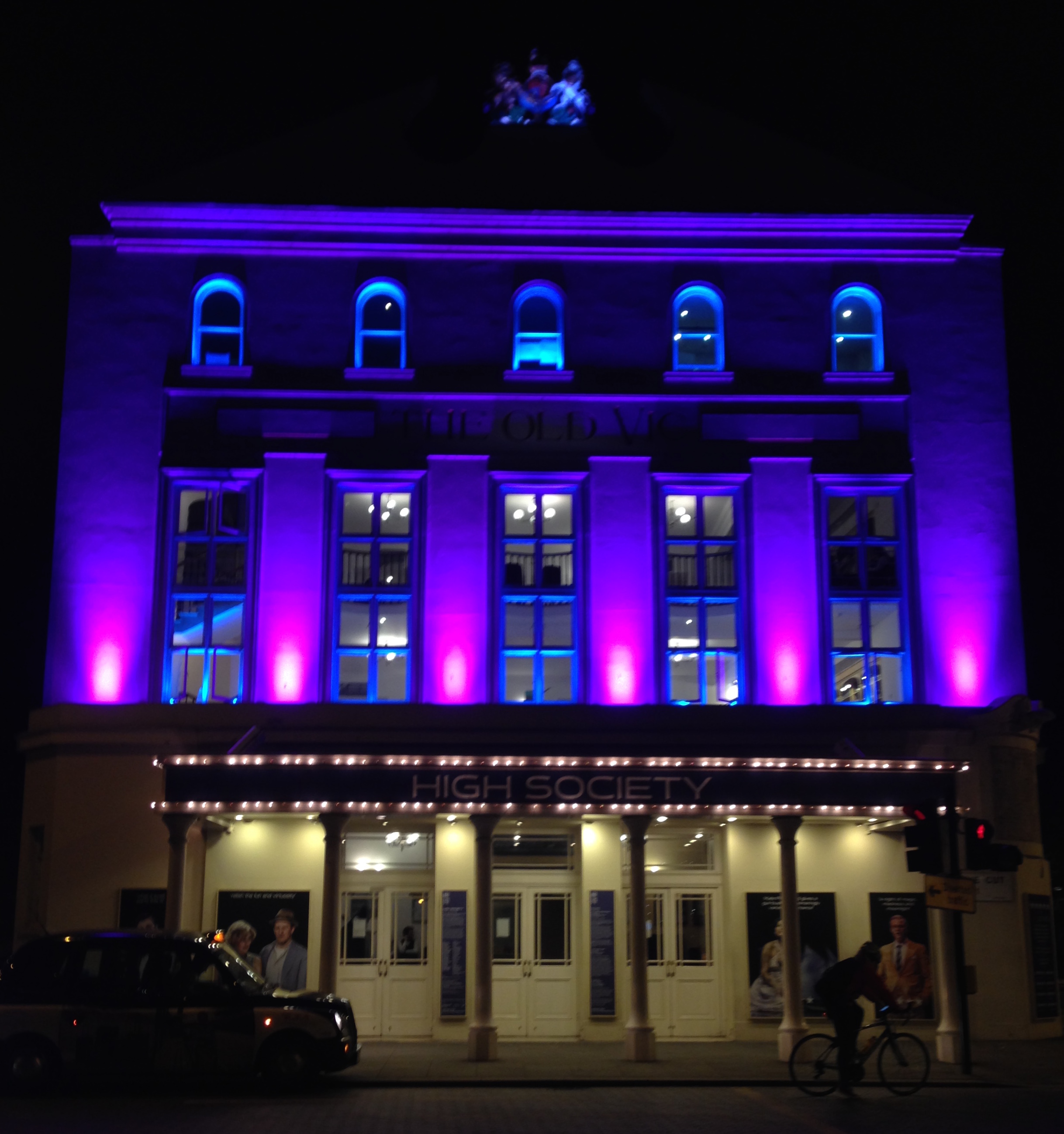
High Society: The Old Vic

IMG_1134

Some complain theatre, especially musical theatre, should not be performed in the round as it spoils the spectacle and so the show. These naysayers should see The Old Vic’s High Society.

Actors appear to blend with ushers, mingling with an unaware audience arriving to cross a stage, empty except for a piano, to take their seats. No lights lower when internationally renowned jazz pianist Joe Stilgoe (or is he Joey Powell?) seats himself, asking the audience for requests.

This could fail spectacularly, instead Powell’s/Stilgoe’s musical dexterity has everyone singing along to Night and Day. He and the cast segue seamlessly into Maria Friedman’s tightly directed show as houselights dim.

The chorus is superb: girls glide, boys bop and in a heartbeat we’re transported to Fifties East Coast America. The intimate production means actors are so close you can smell their cologne and perfume; the show’s slick set changes seamless.

Although you know Dexter (the brilliant Rupert Young) is trouble the minute you see him you forgive his foibles. True, it’s clearly corny but it’s completely captivating. Familiar songs feel fresh and fantastic – you can’t help singing along silently.

This is a musical about deception but the biggest con is on the audience who sit enraptured as both cast and crew charm with their creativity. Staging is sublime – it really is amazing the amount achieved in so small a space. A swimming pool appears on stage courtesy of Peter Mumford’s imaginative lighting.

Kate Fleetwood transfigures the audience, taking them thrillingly through Tracey Lord’s transformation from spoiled society snob to lovely lady.

Barbara Flynn’s performance as Mother Lord is pure Debbie Reynolds with Jeff Sprawle’s surprisingly spry Uncle Willy a wonderful comic foil.

George is played to perma-tanned perfection by Richard Grieve. His smarmy demeanour means you route for love-rival Dexter soon after George first enters.

Hailing from the wrong part of town, reporters Mike (Jamie Parker) and Liz (Annabel Scholey) are all brassy business, in their quest for a tabloid scoop.

Anyone who’s ever been in love and believes in second chances will fall head over heels for this, the perfect curtain call for Kevin Spacey’s stellar run as The Old Vic’s Artistic Director. A magnum of champagne should be raised in his honour.

Yes, cyclists matter – but so does everyone else

Photo: Creative Commons courtesy en.wikipedia.org

Photo: Creative Commons courtesy en.wikipedia.org

You don’t need to go far to see their staggering selfishness, especially in London. Pedestrians and motorists both suffer, watching in anger while these two-wheeled terrors casually weave in and out of traffic, ignoring signs, signals, riding over pedestrian bridges and jumping the kerb. Roads and footpaths belong to them – nobody else.

Disregarding everyone’s safety, including their own, they wear neither helmets nor high-visibility jackets. Lacking lights for dark days and evenings, often in dark clothing as if trying to deliberately remain unseen, the only reason they have reflectors is because these came attached.

The poor woman probably scarred for life recently, after a callous cyclist hit and run on a Bermondsey footpath may be extreme.

But when newspaper headlines shout about another tragic cycling death, sadly few readers admit much sympathy. With little detail, no blame is directed toward the fatally injured cyclist. Readers, although wishing nobody harm, often recall nothing except the recent recklessness they saw or experienced. These images come to mind, not the poor cyclist tragically killed. Subsequently many readers rarely bother continuing past the headlines.

Yes, millions of responsible cyclists do follow road rules, are considerate to those they share streets with and wear correct cycling clothing.

Millions of drivers show similar respect for road safety laws. Most people no more condemn every motorist as irresponsible and dangerous for the few reckless drivers who blight the roads, than they do all cyclists.

One important difference remains though.

Motorists undergo lengthy theoretical and practical training before being allowed behind a car wheel and penalties, should they flout laws, are far more severe.

Cyclists comparatively, can jump on a bike immediately, whether it’s been years since they last cycled or never ridden at all.

The expression: “It’s just like riding a bike,” describes any activity you never forget or can pick up easily after a lengthy break. The irony is this should not apply to cycling, especially through London’s crowded streets.

Cyclists should not be permitted on roads until completion of practical and written road safety tests. If successful, a point-based licence, similar to motorists’ should be issued. Although these tests would be far simpler, cyclists breaking road law should also be penalised by losing points, with fines and, in extreme cases, imprisonment. Laws must include mandatory use of lights and appropriate clothing and a footpath cycling ban. Helmets and jackets should come included with any hire-bike.

This can only prevent, or at least reduce, those tragic cycling fatalities – the cycling campaign groups goal.

There cannot be one rule for motorists and another for cyclists. Yes, there should indeed be more cyclists on our roads, but not at any expense.