When political parties need to professionalise

The News Hub

Natalie Bennett’s disastrous week mean urgent lessons must be learned, by her and the entire Green Party.


Rob Whitson in UK Politics

28 Feb 2015, 01:04 GMT | Comments (1) | Report

Green leader Natalie Bennett at the party’s ill-fated election policy launch (Photo: Creative Commons)

Insurgent parties, like the Greens and UKIP are receiving the widespread media coverage they craved for so long. This, as they are discovering the hard way, is a double-edged sword.

Continue Reading…

Bull: Young Vic Theatre

Featured image

©iStock.com/AdrianHillman

The empty boxing ring of Soutra Gilmour’s stark stage cleverly evokes conflict even before Mike Bartlett’s Bull begins. With the front few rows removed from The Young Vic’s in the round production, many audience members stand, some hanging off the metal barrier surrounding the arena-like stage.

With Peter Mumford’s harsh overly bright stadium style lighting and thumping motivation music used before the play starts, audience anticipation is heightened for a fight. Only a water cooler in one corner and familiar generic carpet seem oddly out of place, hinting at the play’s office setting.

The tension between Thomas (Sam Troughton) and Isobel (Eleanor Matsuura) is evident the moment both enter the “ring”. The verbal sparring is mutual but it’s quickly clear Thomas is on the ropes. Superior in every way, Isobel toys with Thomas the way a bored cat plays with an injured bird. Thomas valiantly tries to keep up but, rapidly realising his inadequacy, every insult seems to visibly crumple him.

The entrance of Adam James’ swaggeringly sadistic Tony could not come at a worse point for Thomas. Tony immediately joins Isobel in her sadistic game, a game in which one player doesn’t understand the rules and struggles to keep up.

Like nasty schoolchildren tormenting a weaker classmate, the childish cruelty becomes increasingly vindictive and difficult to watch. Audience laughter at occasionally amusing insults hesitates, gets more infrequent. At first almost silly, put downs become increasingly personal. Alliterative sentences are thrown like darts designed to hurt and they do – you feel for Thomas’ struggling, vainly, to survive.

The entire cast is pitch perfect. Matsuura’s Isobel resembles a beautiful deadly animal – you want to look away but remain fascinated by her viciousness unable to avert your gaze.

Troughton’s performance as the tragic Thomas is almost too painful to watch. He plays straight into his colleagues’ hands, becoming increasingly hysterical and paranoid after their boss, Neil Stuke’s cool, collected and equally cruel Carter enters. As it quickly becomes clear Carter is playing too for Thomas, the game is lost. Facing all three in a wall of hostility and complete indifference, his career disintegrates.

Clare Lizzimore’s taut direction is superb. Using the minimal space to devastating effect, the action is relentless and the production’s every phrase painful. Even worse than the verbal venom in Bartlett’s savage play are his Pinter-like pauses. Almost eternal they swallow poor Thomas, further wearing him down.

Despite Thomas’ career crucifixion, this humiliation still isn’t enough for his antagonists. Their poorly pretended pity is even crueller, the final scene delivering a hammer blow.

Although brief, nearly an hour of non-stop spite makes Bartlett’s Bull an emotionally exhausting albeit, timely, comment on today’s target driven, professionally preoccupied world.

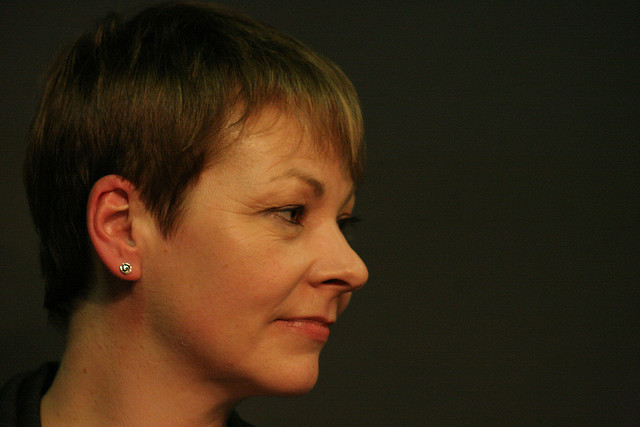
Caroline Lucas: the media’s our problem

The News Hub

The Green MP discusses her party – its policies, popularity and how to be heard above UKIP

The ugly face of British nationalism

EDL Rally (Photo: Rob Whitson)

EDL Rally (Photo: Rob Whitson)

In Whitehall on lawns opposite Downing Street, something other than the cool change made me shiver Saturday.

Exiting Charing Cross station numerous St George’s flags are visible, flying at the top of Whitehall near Trafalgar Square. My first thought is Unionists are celebrating their referendum victory. Getting closer, the flags’ and separate banners’ slogans: “No Surrender”; “No More Mosques”; “No Sharia Law”; “Supporting Our Troops” reveal a more sinister, dangerous nationalism though.

Asking one of many police nearby, I’m told the English Defence League (EDL), the South East Alliance and other far-right groups are uniting in protest against the “Islamic threat” to Britain. Previously dismissing them as mere lunatic fringe groups, I’ve always walked past. This time I follow to see what exactly they hope to gain.

There’s a raucous march down Whitehall, EDL supporters yelling and chanting. They try to get as close as possible opposite Downing Street when they’re confronted by a small but highly vocal anti-fascist rally organised in opposition. The police keep both groups apart. Once the EDL are set up on the MoD lawn more police line up to separate them from the traffic and tourists walking past to Westminster and Number 10. It strikes me just how many police there are and what else they could be doing.

Standing on the small island surrounding the Women of World War Two monument in the middle of the road, I watch and listen.

One of the most noticeable things is how clearly inarticulate and badly educated most of the crowd, consisting of men, women and children of all ages are, including nearly all the speakers.

An elderly English couple visiting London are standing nearby taking photos. We begin talking, their contempt for the group opposite quickly becoming apparent. I point out just how young some of the children are – mostly “mini-mes” of the men with matching football shirts and shaved heads.

“Look – they don’t stand a chance. They’re indoctrinated with this idiocy. Give me the child and I’ll show you the man,” says the gentleman.

I point out how few people are actually there in opposition to the rally and the numbers of people who walk by, seemingly oblivious.

“They don’t call them ‘the silent majority’ for nothing do they? What worries me is it’s the squeaky wheel that’s getting the oil now. Look at the rubbish the politicians are coming up with to counter Salmond and UKIP,” the woman says.

Their main speaker, sacked UKIP parliamentary candidate Paul Weston is now head of the far-right Liberty GB. Weston rants about Rotherham child abuse and ISIL, reading what he claims are Sharia Law edicts condoning rape and murder. Whipping the 200 or so strong crowd into a frenzy, he claims Islam is a “cult not a religion”.

Frighteningly familiar complaints begin about British jobs for British citizens, foreigners on benefits and the blood of brave British troops being spilled to battle Islam’s evil influence.

Nearby stands Viscount Alanbrooke’s statue, one of Britain’s great Second World War heroes. One of the soldiers they believe they fight for he looks away, seemingly embarrassed.

Stressing today’s event is going well and how pleased police are with today, Weston emphasises its peaceful nature. The speech stops to rapturous applause as the EDL anthem is played via speaker: “We’re coming! We’re coming! We’re coming down the road! We’re volunteers of the EDL, we’re coming down the road!”

Everyone’s chanting the words when, with no warning, protestors, police and paparazzi run back towards Trafalgar Square. Keeping up, a freelance photographer explains to me despite common beliefs rival groups usually fight among themselves over who’s more far-right. When we arrive at a pub on the northern end of Whitehall the brawlers have fled into the West End.

I stand by Northumberland Avenue taking notes watching as a large group of 20-somethings make monkey noises in earshot of a lone black police officer. He smiles politely. His white colleagues nearby however fail to intervene despite police easily outnumbering protestors by about three to one.

Asking the officer how he feels about all of this he just shrugs.

Seeing me taking notes one of his colleagues asks if I’m a journalist. I explain I’m just starting, my first time covering anything like this and my surprise at the number of police. Explaining this, he goes on to confirm something else I’d noticed:

“It’s the first time we’ve had such a poor show from the anti-fascists.

“The EDL are usually the better behaved out of all of them. The problem is they cause such an adverse negative ripple around them.”

Asking why he did nothing to stop the monkey chants he says he didn’t hear them: “You get used to that in the police. Things like: “bacon” “Laurel and Hardy” – you’ve got to develop a thick skin.” Again, his black colleague shrugs.

I point out how similar their demands seem to be to UKIP’s and how other more mainstream parties seem to be increasingly competing on the same nationalist platform in response to their recent success. I give the forthcoming Clacton by-election as evidence.

“Yes. It’s worrying,” the black officer says.

“No I don’t think they’ll ever get a real voice,” the white officer says. I walk away, having seen and heard enough.

Reasons to believe

images

Photo: flickr.com courtesy Creative Commons

There’s a reason I still have faith in humanity.

I left the house to get groceries on Sunday in a foul mood. Passing an empty beer bottle slung by some slob into the planter outside my building only confirmed a belief the world was going to hell in a hay-cart. All day I’d felt disappointed and let down due to a good friend’s behaviour the previous evening while at my place for dinner.

I enjoy cooking for others and always make an effort. Taking advantage of the fact I live within walking distance of the culinary mecca that is Borough Market, I’d spent more than I should and most of the morning fighting crowds to get the necessary ingredients.

Most of the afternoon was spent slaving over a hot stove while preparing my culinary output for the evening. Then, before my guests arrived, the flat was cleaned and the music chosen, all with the intention of being the best host possible. My anticipation quickly became bemusement when the first of these friends turned up drunk.

Please don’t misunderstand me – I’m certainly not anti-alcohol and, indeed, enjoy a bottle of red myself most weekends. In fact I’d purchased a couple of excellent bottles for both my guests and I to share that evening. What I found so annoying was this person – someone who frankly, should know better, couldn’t be bothered to wait for the rest of us.

Many readers simply won’t understand why this upset me. The closest comparison I can draw for their benefit is, if having prepared dinner early, I proceeded to sit down and started eating the dessert before my guests even walked through the door.

Sadly I think my friend’s behaviour is indicative of a much wider, far more serious problem affecting society. Something that, despite its seriousness can be summed up in three short words: lack of courtesy.

Unfortunately said friend’s social misdemeanours did not end there. Throughout the evening they spent most of their time, including while seated at the table eating dinner with the rest of us, texting someone due to the possibility of getting lucky later. Again, call me old-fashioned, but I was raised to believe if someone invites you to their home and takes the time to cook a meal for you, the very least you can do is pay attention to what they and everyone else present are saying. More lack of courtesy.

I was walking back from the supermarket bemoaning this person’s behaviour during a call to another friend, someone who shares my mostly jaundiced view of the way people treat each other these days. He was appalled, as I knew he would be. He knows the person in question and, like me, usually has a high opinion of him.

As we spoke, I realized I’d forgotten to buy something so needed to pop into the little supermarket beneath my building. After explaining this, I promised to call again when I was back in my flat. Unlike some people I don’t think it’s civilised or necessary to walk around a store talking on my mobile. I also feel even though you’re not friends and they’re only doing their job, the very least you can give anyone serving you is your attention and a smile.

It amazes me how many people I see in shops completely ignoring the person serving them. Any acknowledgement they manage is little more than a nod while they conduct an entirely different conversation on their mobile phone about football, EastEnders or what Becky in accounting did at the pub Friday. Again: lack of courtesy.

After buying what I needed, while walking back to my building’s entrance I noticed a guy cutting branches away from a tree on the kerb that had become especially overgrown around the base. Only the other day I’d been thinking how untidy this was and how much it spoiled the surrounding area.

Believing he was a council worker, I stopped to thank him for a job well done and coming out on a Sunday but recognized him as someone who lived in my building. Appreciation quickly became admiration. I congratulated him for taking time out of his Sunday to do a job the hundreds of other occupants in my building and those surrounding it, including myself, simply couldn’t be bothered to do.

Retracing my steps, I picked up the empty bottle from the planter on the way in, stopping in my building’s bin area to put it in with the recycling. Phoning my friend to continue our conversation, I told him what happened and he agreed: despite the rudeness epidemic sweeping the modern world there are still many good, considerate people out there.

It’s funny how the universe works.

Facebook’s not all bad…

(Image: Creative Commons)

Image: Creative Commons

Not a big fan of Facebook, if I’m honest, I avoid it when possible. I’ve never collected friends the way kids collect trading cards nor have any inclination while I’m enjoying myself somewhere to stop and share this electronically.

Those few times I do log on I tend to find the stream of updates banal and unimaginative, and people’s repetitive rambling irritating. The surest way to spoil a nice Friday evening in alone is to read endless postings of everyone else apparently celebrating without you. It does however, have uses.

However, it is a good way to maintain contact with friends many miles away, and an excellent method of tracking down people you’ve lost touch with completely. I was contacted last week by someone I hadn’t heard from in 28 years who I went to high school with. Having lived in London since I was 19, I go home only to see family every five years or so. The flight’s too long, expensive and tiring at 44.

Struggling with my sexuality in macho Australia at high school was a difficult bittersweet time for me. Like most people I had some of the worst and best experiences of my life there during the five years it covered.

A group of us were extremely close but when it was over for me, it ended abruptly. My Mum died after a short bout of cancer just after I received my final exam grades and, after coming out, I dropped out of university to move in with my first partner and severed nearly all former social ties.

In the past few days I’ve chatted with people I haven’t spoken to in years, picking up the phone without hesitation and little embarrassment. Old memories came flooding back.

Sometimes you can go home again.

Britain’s hidden epidemic

(Picture: Wikipedia courtesy Creative Commons)

(Picture: Wikipedia courtesy Creative Commons)

Third Year Broadcast Project

I chose epilepsy as the topic for my major final year project. My aim was to highlight the general lack of knowledge in the UK about epilepsy and the problems this causes sufferers.

Final Year Print Project

You don’t expect a former cab driver who, but for poor eyesight would be a pilot to be running an award-winning interior supplies business specialising in unique surface materials. However, that’s not the only thing that sets Fameed Khalique apart from others in the crowded, competitive interiors market…

Read more.

The Mindfulness Revolution

(Photo: flickr.com courtesy Creative Commons)

(Photo: flickr.com courtesy Creative Commons)

The Wall Street Journal recently claimed mindfulness-based meditation’s health benefits were limited. However with mindfulness recently on Time’s front-cover, and Mindfulness Apps available for mobiles, this apparently contradicts other publications and many people’s experience.

Adrian Rides, mindfulness practitioner and teacher for over 10 years based at The Now Project, describes mindfulness as a meditative way of observing your own thoughts while still fully engaged in daily activities: “It’s about waking up – being as alert, alive as possible to this moment so your attention is 100% in the present. When you do that, something happens: your thinking quietens – it creates a quiet space called thoughtless awareness…,

“Accessing thoughtless awareness allows you to engage fully – free of the dialogue in your head. For many people that dialogue’s not altogether comfortable and it could be downright destructive and painful. So to be able to consciously choose to step out of the dialogue in your head’s quite a nice ability to have.”

Doing this without judging or trying to change your thoughts you discover nearly all your emotional discomfort – guilt, fear, anger etc., proponents claim. This isn’t caused because of what’s really happening but by our own thoughts. Once you see this you can decide to just withdraw your attention from the discomfort. Because you wouldn’t choose to be in discomfort, things change and you begin to feel better.

Medical News Today criticised limited research supporting The Wall Street Journal’s and similar articles, downplaying mindfulness’ benefits. That doctor believes the medical profession must update its awareness of the benefits mindfulness based therapy offers.

Paul Vallins, a client of Mr Rides agrees. A cocaine addict for ten years, he’s been clean for seven – something he attributes to mindfulness.

“It’s a completely different reality I’m living in,” he says.

“It takes practice. It’s difficult. Your mind doesn’t want to give up. There’s the ego in the pain body you must deal with. The ego’s your false sense of self… who you think you are.

“I was in a lot of pain then so at first practising was easy for me because there was no way out and that happens to lots of people I find. You take mindfulness on, it comes from a place of: they need to surrender.”

Mr Vallins now has a roofing business and teaches mindfulness himself. Mindfulness continues growing in popularity – even MPs take mindfulness classes in Westminster. It seems anyone really can benefit.